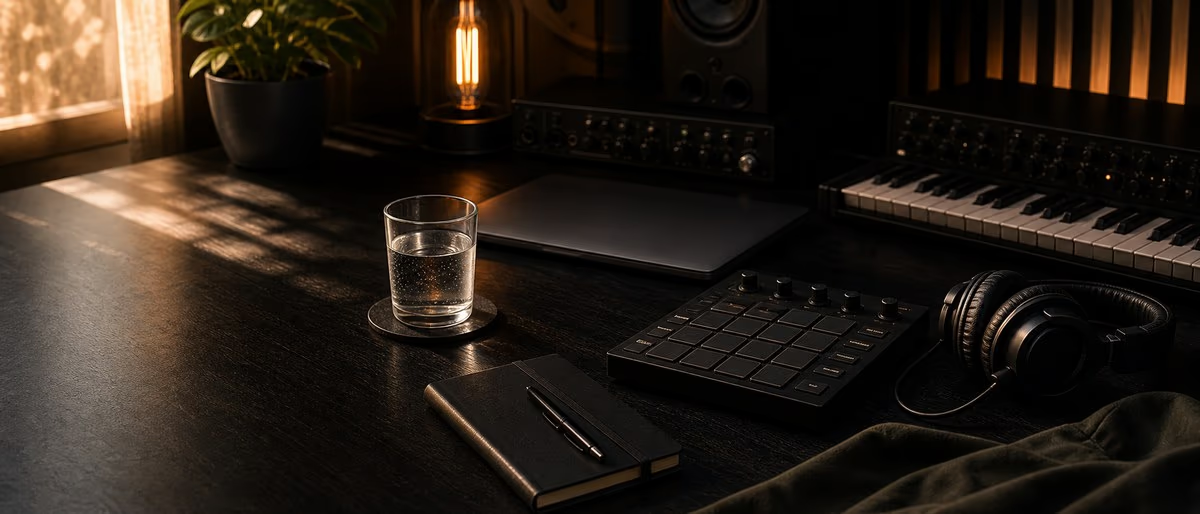
The Post-Production Nausea Phenomenon
Beatmakers experience a unique form of creative fatigue that guitarists, vocalists, and DJs rarely encounter. It is called post-production nausea — the psychological rejection of your own work after hearing it on loop for hours.
When you build a beat, you hear the same 8-bar loop 200-400 times in a single session. Your brain adapts through a process called neural habituation — the same mechanism that makes you stop noticing a clock ticking after five minutes. The problem: habituation does not discriminate between annoying sounds and creative work. Your brain literally stops responding to your own beat as if it were background noise.
The Neuroscience of Auditory Fatigue
Your auditory cortex processes sound by identifying patterns and predicting what comes next. When a loop repeats predictably, the cortex reduces activation — it delegates the task to lower-level processing and stops engaging higher creative circuits.
This is why your beat sounded incredible at bar 16 and boring at bar 200. The music did not change — your brain stopped paying attention. Research on repetitive sound exposure shows that dopamine release in response to music drops by 40-60% after the 50th repetition. For beatmakers, this happens in under an hour. The result: you start second-guessing every choice, adding unnecessary layers, or abandoning the project entirely.
Exercise: The 48-Hour Detox
The 48-hour detox is a hard rule: after any session longer than 90 minutes, you are forbidden from listening to that project for two full days.
This is not a suggestion — it is a protocol. Export a rough bounce, name it clearly, close the project, and do not reopen it. The 48-hour window allows neural habituation to reset. When you return, your brain processes the beat as fresh input, not background noise. Most producers report that 70% of their perceived problems disappear after the detox. The remaining 30% are real issues worth fixing.
Technique: The Blind Drop
Visual feedback from your DAW creates a second layer of fatigue. You start making decisions based on what looks right on the piano roll rather than what sounds right.
The blind drop removes visual bias. Close your eyes or turn off your monitor. Set a 15-minute timer and build an 8-bar section using only your ears. Do not look at waveforms, meters, or the arrangement view. Force your auditory cortex to do all the work. This technique reactivates the neural circuits that habituation has shut down. Producers who use the blind drop report higher satisfaction with their work and fewer unnecessary revisions.
Practice: Fresh Ears Exchange
Your ears are the worst judge of your own unfinished work. You know what you intended, so you hear intention instead of reality.
Find one other producer you trust. Exchange unmixed, unmastered 16-bar loops every week. Each person writes three sentences of feedback: what works, what confuses, what they would change. This is not collaboration — it is diagnostic. Fresh ears catch problems you have habituated to and validate strengths you have stopped hearing. The exchange also creates accountability: knowing someone else will listen keeps you from abandoning projects prematurely.
Chronic Burnout vs. Normal Fatigue: How to Tell the Difference
Not all creative fatigue is burnout. Understanding the difference prevents you from taking unnecessary breaks or, worse, pushing through real burnout.
Normal fatigue resolves with sleep, a day off, or switching projects. You still feel curiosity about music. Chronic burnout persists for weeks. You dread opening your DAW. Listening to music — any music — feels like work. You experience physical symptoms: tension headaches, jaw clenching, or insomnia after sessions. If you have three or more chronic symptoms, stop producing for 7-14 days. Not a reduced schedule — a full stop. Burnout is an injury, not a mood.
When to Pause, When to Switch, When to Push Through
The hardest decision in production is knowing whether a project needs more time, a different approach, or abandonment.
Pause when you have spent more than 3 hours on a single 8-bar section without meaningful progress. Export and walk away. Switch when you have tried three different approaches to the same problem and none feel right. Start a new beat with a different tempo, key, or sample source. Push through only when you have a clear vision and the obstacle is technical — a sound you cannot quite get, a mix element that needs adjustment. Never push through when the obstacle is emotional. Emotional resistance is data, not weakness.
Normal Fatigue vs. Chronic Burnout
| Symptom | Normale Müdigkeit | Chronischer Burnout |
|---|---|---|
| Dauer | 1-2 Tage | 2+ Wochen |
| Interesse an Musik | Bei einem Projekt reduziert | Bei aller Musik reduziert |
| Körperliche Symptome | Leichte Augenbelastung | Kopfschmerzen, Schlaflosigkeit, Spannung |
| Erholung | Schlaf, freier Tag | Längere Pause, Lifestyle-Änderung |
| DAW-Reaktion | Fühlt sich langsam an | Fühlt sich aktiv stressig an |
| Kreative Neugier | Kommt schnell zurück | Wirkt fremd oder entfernt |
Burnout Recovery Protocol: 5 Steps
- Alle aktiven Projekte exportieren und benennen: 1 Rough Bounces der letzten 30 Tage in einen Detox-Ordner legen.
- 48-Stunden-Hörverbot planen: 2 Keine eigene Musik für 48 Stunden hören.
- Eine Blind-Drop-Session machen: 3 Monitor aus, 15 Minuten, etwas Neues nur nach Gehör bauen.
- Fresh-Ears-Austausch einrichten: 4 Einen Producer für wöchentliches kurzes Feedback anfragen.
- Physisches Setup prüfen: 5 Monitorhöhe, Stuhl, Licht und Ergonomie verbessern.
Learning path
Related answer hubs
article.relatedPostsTitle
![Udemy Pop and RnB Music Production with Ableton Live 12 [TUTORiAL]](/images/posts/udemy-pop-and-rnb-music-production-with-ableton-live-12-84361-326w.avif?v=20260630)
Udemy Pop and RnB Music Production with Ableton Live 12 [TUTORiAL]
![Singing Success 360 The Complete Method (SS360) [TUTORiAL]](/images/posts/singing-success-360-the-complete-method-ss360-84348-326w.avif?v=20260630)
Singing Success 360 The Complete Method (SS360) [TUTORiAL]
![On Point Samples The Industrial Rawstyle Kick System [WAV, Synth Presets, TUTORiAL, DAW Templates]](/images/posts/on-point-samples-the-industrial-rawstyle-kick-system-84280-326w.avif?v=20260630)
On Point Samples The Industrial Rawstyle Kick System [WAV, Synth Presets, TUTORiAL, DAW Templates]
![FaderPro The One Hour Mixing Workflow [TUTORiAL]](/images/posts/faderpro-the-one-hour-mixing-workflow-84119-326w.avif?v=20260630)
![Udemy Learn Piano The Easy Way A Beginner's Guide [TUTORiAL]](/images/posts/udemy-learn-piano-the-easy-way-a-beginners-guide-84213-326w.avif?v=20260630)
Udemy Learn Piano The Easy Way A Beginner's Guide [TUTORiAL]
![Truefire Polyrhythm and Advanced Rhythm Training (JamPlay) [TUTORiAL]](/images/posts/truefire-polyrhythm-and-advanced-rhythm-training-jamplay-84170-326w.avif?v=20260630)
Truefire Polyrhythm and Advanced Rhythm Training (JamPlay) [TUTORiAL]
Przeglądaj darmowe narzędzia do miksu.
Przeglądaj darmowe pobraniaBurnout Recovery: Common Questions
- Jaki pierwszy krok przy Why Beatmakers Burn Out Faster Than Other Musicians and How to Get the Spark Back?
- Trzymaj kolejność sekcji — wyrównaj poziomy przed efektami.
- Czy darmowe narzędzia wystarczą do Why Beatmakers Burn Out Faster Than Other Musicians and How to Get the Spark Back?
- Darmowy łańcuch TDR, Valhalla, Youlean wystarcza w home studio.
- Jaki cel LUFS dla Why Beatmakers Burn Out Faster Than Other Musicians and How to Get the Spark Back?
- Streaming około −14 LUFS zintegrowane, true peak poniżej −1 dBTP.
- Jak Plugg Supply łączy się z Why Beatmakers Burn Out Faster Than Other Musicians and How to Get the Spark Back?
- Zweryfikowane sample i pluginy skracają workflow.