
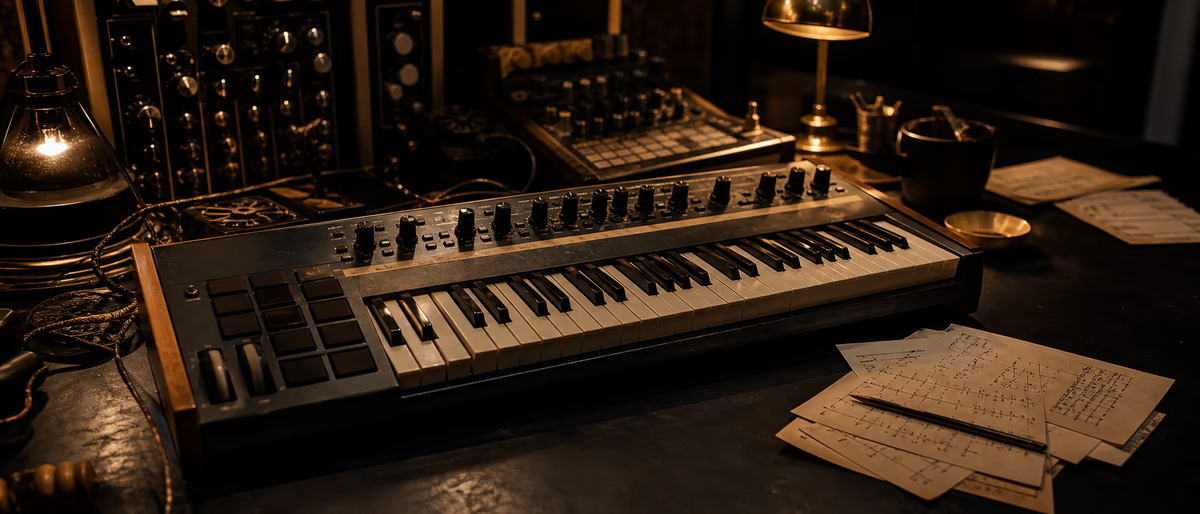
Humanizing AI music drafts 2027
Szybka odpowiedź
In 2027, humanizing AI music drafts means improving musical quality — timing, velocity, arrangement, and performance — and handling disclosure/compliance honestly. It is not a guide to fraudulently evade detectors or misrepresent authorship. Replace robotic drums, vary velocities, add micro-timing, re-record key parts, and disclose AI use when rules require it.
Ethical Reframe: Quality and Compliance, Not Evasion
Search interest often clusters around “avoid AI detection.” That framing pushes people toward deceptive goals: smuggling fully synthetic tracks into contests, playlists, or licenses that require human authorship.
This article takes a different stance. If you use generative tools (Suno, Udio, MIDI generators, AI stems), you should humanize drafts so they sound intentional and playable, and you should follow disclosure rules for platforms, labels, schools, and clients. Improving feel is legitimate craft. Misrepresenting origin to break rules is not.
Related reading: AI music disclosure, AI detection tools, AI music copyright, and AI MIDI humanization.
- Do Use AI as a sketch; replace drums; rewrite melodies; record real vocals; document your process; disclose when required.
- Don’t Sell unauthorized voice clones; claim “100% human” against contract terms; rely on “detector beaters” as a business model.
Why AI Drafts Feel Robotic
| Symptom | Musical cause | Humanize move |
|---|---|---|
| Drum machine stiffness | Identical velocities and perfect grid | Velocity layers + swing + ghost notes |
| Dead bass | Static note lengths; no slides/articulation | Re-program or re-record with expression |
| Plastic vocal | Over-quantized tuning; even dynamics | Re-sing; keep breaths; automate less |
| Loop fatigue | 8-bar copy-paste forever | Arrangement edits, fills, mutes, breakdowns |
| Stereo smear | Over-wide generative mix | Mono bass; tighten sides; rebalance |
Concrete Parameters: Velocity Ranges
MIDI velocity (1–127) is the fastest humanizer for programmed drums and keys. AI MIDI often parks everything near one value.
| Part | Suggested velocity range | Pattern tip |
|---|---|---|
| Kick (main hits) | 100–120 | Keep relatively stable; drop 5–10 on quieter sections |
| Snare / clap backbeats | 95–118 | Slight variation between even bars |
| Ghost snares / rims | 35–65 | Fill gaps without competing with backbeat |
| Closed hats (groove) | 45–90 | Accent every other 8th or off-beat; rise into rolls |
| Hat rolls | 60 → 110 (crescendo) | Linear or curved ramp over 1/4–1/2 bar |
| Perc / shaker | 40–85 | Avoid static loops at velocity 100 |
| Melodic stabs | 70–110 | Phrase accents on chord changes |
If your sampler ignores velocity, enable velocity→amp or velocity→filter. Humanization is useless if the engine does not respond.
Swing Percentages and Micro-Timing (ms)
| Feel goal | Swing / groove starting point | Micro-timing notes |
|---|---|---|
| Straight modern trap hats | 0–8% swing on 1/16 | Nudge occasional hats ±5–12 ms later for lazy feel |
| Bouncy hip-hop | 12–25% on 1/16 (DAW-dependent scale) | Snare can sit 5–15 ms late; kick more on-grid |
| UK drill lean | Subtle swing; space > shuffle | Leave intentional gaps; don’t “humanize” every 16th |
| House / four-on-floor | Light 1/16 shuffle if any | Keep kick tight; swing perc and hats more than kick |
| Live band emulation | Groove pool from a real drum loop | Extract timing from a human loop; apply to MIDI |
- Micro-timing budget For electronic genres, ±5–20 ms on selected hits is often enough. ±40–80 ms starts to feel sloppy unless you want lo-fi chaos.
- Quantize strategy Do not 100% quantize then 100% humanize randomly. Quantize strength 70–90%, then hand-edit accents and off-beats.
- Swing is not a moral shield Adding swing does not “erase” AI origin for legal or contest purposes. It makes music feel better.
Replace Drums, Re-Record Bass, Rewrite Melodies
- Stem or mute the AI drums
Keep the generative track as a reference bus at low volume. Rebuild kick, snare, hats with your one-shots. - Re-voice the bass
Retune an 808 kit sample or re-play MIDI with glide for drill; avoid leaving static generative sub loops. - Rewrite at least one melodic motif
Change contour or rhythm so the song is not a near-copy of the model’s first idea. - Record a human performance layer
Even a simple guitar, vocal chop you sang, or perc you tapped adds non-AI entropy that helps artistry. - Arrange with intention
Add breakdowns, mutes, and filter rides. AI full-length tracks often overstay a loop.
For stem tools and rights caveats, see free AI music tools 2027. Stemming a commercial song you do not own is still a rights issue even after humanization.
Mix Moves That Make Drafts Release-Ready
- Gain staging AI exports often arrive hot. Pull down clips; leave master headroom before limiting.
- Mono the sub Collapse bass below ~120 Hz to mono; fix phasey generative lows.
- Control harsh highs Dynamic EQ on hats/vocals in the 5–10 kHz zone if the draft is brittle.
- Reverb as glue, not fog Shorter spaces on drums; longer only on selected melodic tails.
- Reference match carefully Use references for balance, not to launder identity. See mastering guidance in AI vs human mastering 2027.
Platform and Partner Disclosure (High-Level)
Rules change. The following is general guidance, not legal advice:
- Distributors and stores Some ask whether AI was used in creation. Answer according to their definitions; keep process notes.
- Labels, publishers, sync Contracts may require warranties about authorship and samples. Disclose AI assistance early.
- Contests and grants Many ban or limit generative audio. Read rules before entering; humanization does not always equal eligibility.
- Collaborators Tell featured artists if the beat started as an AI draft so splits and credits stay clean.
- Fans Optional culturally, sometimes smart for trust. Forced secrecy ages poorly when tools are obvious.
Detection tools used by platforms and educators are imperfect. Building a career on “beating detectors” is fragile. Building a career on taste + documented process + honest deals is not.
60-Minute Humanize Session Recipe
- 0–10 min — Import and label
AI draft on a reference track; note BPM/key; set project grid. - 10–25 min — Rebuild drums
New kit; velocity table; light swing; one fill language. - 25–40 min — Bass and music
Reprogram 808/bass; edit melody; add one human layer. - 40–50 min — Arrangement
Cut fat; add breakdown; automate filter/mute for lift. - 50–60 min — Mix pass + export notes
Balance, mono check, rough limit; write disclosure note if needed for the release path.
What Success Sounds Like (Musical Goals)
A successful humanize pass is easy to hear without any detector UI:
- Groove has weight and air Hats and ghosts create push/pull; silence is part of the pattern.
- Bass talks Notes have length variety, mutes, or slides — not a flat MIDI rectangle loop.
- Sections differ Verse energy is not identical to chorus energy; something mutes, opens, or layers.
- You can perform it If you cannot tap the groove or sing the hook naturally, keep editing.
- Paperwork matches the art Credits, splits, and disclosure notes match how the track was actually made.
If your only success metric is “a website says this is human,” you are optimizing the wrong target. Optimize for listeners, collaborators, and contracts.
Pair ethical AI workflows with free mix tools and samples on Plugg Supply.
Learning path
Powiązane answer huby
Powiązany katalog
Więcej tutorials z katalogu
Więcej tutorials z kanału Plugg Supply, uszeregowanych według popularności katalogu.
![Music Hackspace Getting started with Javascript for Max by Umut Eldem [TUTORiAL]](/images/posts/music-hackspace-getting-started-with-javascript-for-max-by-u-86125.avif?v=2026080101)
LEARNING / VIDEO TUTORIALS
Music Hackspace Getting started with Javascript for Max by Umut Eldem [TUTORiAL]
![Music Hackspace Getting Started With Interactivity With Max by Kyle Duffield [TUTORiAL]](/images/posts/music-hackspace-getting-started-with-interactivity-with-max--86081.avif?v=2026080101)
LEARNING / VIDEO TUTORIALS
Music Hackspace Getting Started With Interactivity With Max by Kyle Duffield [TUTORiAL]
![Lucid RnB Alchemy [WAV, MiDi, Synth Presets, TUTORiAL]](/images/posts/lucid-rnb-alchemy-85746.avif?v=2026080101)
Sample'y / Presety / MIDI / VIDEO TUTORIALS
Lucid RnB Alchemy [WAV, MiDi, Synth Presets, TUTORiAL]
![MixWithTheMasters Beck Recording and Producing Ride Lonesome [TUTORiAL]](/images/posts/mixwiththemasters-beck-recording-and-producing-ride-lonesome-86013.avif?v=2026080101)
LEARNING / VIDEO TUTORIALS
MixWithTheMasters Beck Recording and Producing Ride Lonesome [TUTORiAL]
Powiązane artykuły
LEARNING / VIDEO TUTORIALS
Music Hackspace Getting started with Javascript for Max by Umut Eldem [TUTORiAL]
LEARNING / VIDEO TUTORIALS
Music Hackspace Getting Started With Interactivity With Max by Kyle Duffield [TUTORiAL]
Sample'y / Presety / MIDI / VIDEO TUTORIALS
Top 2%Lucid RnB Alchemy [WAV, MiDi, Synth Presets, TUTORiAL]
LEARNING / VIDEO TUTORIALS
MixWithTheMasters Beck Recording and Producing Ride Lonesome [TUTORiAL]
![Truefire Bass Soloing Studies Vol.2 [TUTORiAL]](/images/posts/truefire-bass-soloing-studies-vol2-85693.avif?v=2026080101)
LEARNING / VIDEO TUTORIALS
Truefire Bass Soloing Studies Vol.2 [TUTORiAL]
![Udemy Singing Mastery Holistic Method To Sing Freely [TUTORiAL]](/images/posts/udemy-singing-mastery-holistic-method-to-sing-freely-86017.avif?v=2026080101)
LEARNING / VIDEO TUTORIALS
Udemy Singing Mastery Holistic Method To Sing Freely [TUTORiAL]
Często zadawane pytania
- How do I avoid AI detection in my music?
- Focus on legitimate humanization for quality and follow disclosure rules. Trying to fraudulently evade detectors to break platform or contest rules is not recommended and may still fail.
- What velocity ranges humanize trap hats?
- Try closed hats across roughly 45–90 with accents and rolls that crescendo toward 100–110. Enable velocity sensitivity on the sampler.
- How much swing should I add?
- Start subtle (about 0–8% for straight trap hats; higher for bouncier feels) and judge by genre. Kick usually stays tighter than hats.
- Does micro-timing remove AI origin?
- No. Timing edits improve feel. Origin, contracts, and disclosure are separate issues.
- Should I replace AI drums entirely?
- Often yes for release-quality beats. Keep the AI drums as a low-level reference while you program your own kit.
- Do I need to disclose AI if I heavily edited the track?
- It depends on the platform, contract, or contest definition of AI use. When rules are broad, disclose or ask. Keep process documentation.
- Is re-recording vocals enough?
- Real vocals help artistry and originality but may not satisfy rules that restrict any generative composition. Check the specific policy.
- What is the fastest humanize checklist?
- Velocity variety, light swing, rebuild drums, expressive bass, arrangement contrast, mono sub, and honest disclosure when required.